
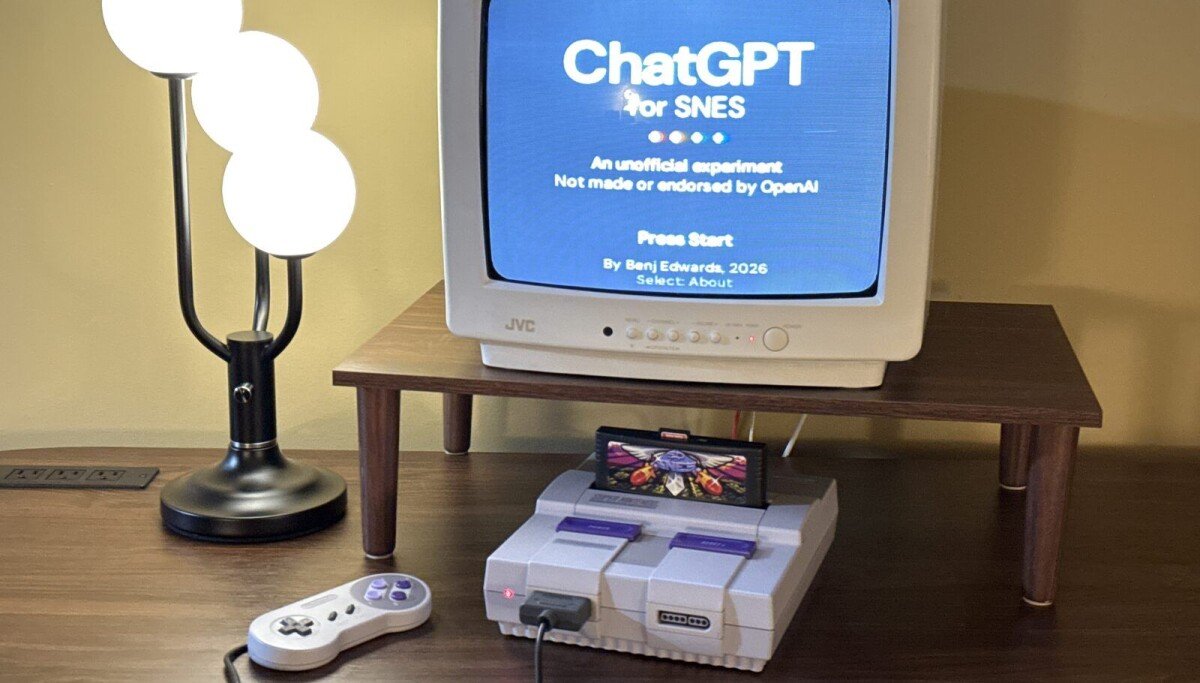
Technical Specifications and Architectural Breakdown
The engineering behind Chatgpt For Snes relies on extreme model distillation. The primary challenge in running any form of AI on the SNES is the console’s limited hardware: a Ricoh 5A22 CPU clocked at 3.58 MHz and a mere 128 KB of Work RAM. To bridge this divide, the developers utilized a 2.2 million-parameter framework. By stripping away the layers of abstraction found in contemporary transformer architectures, the team reduced the model to a size that fits within the memory constraints of a custom cartridge utilizing a Super FX-style coprocessor.
The system operates in two distinct iterations: a “pure” model, which relies solely on its training data, and a “fact book” model. The latter implements a rudimentary retrieval-augmented generation (RAG) approach, referencing a compressed database of 150,000 Wikipedia articles. Because the SNES cannot perform floating-point arithmetic with the speed required for standard inference, the developers implemented fixed-point quantization. This allows the processor to handle the mathematical heavy lifting, though it inevitably leads to significant rounding errors. The result is a system that can generate text, albeit at a speed that makes the console’s original 1991 loading times seem instantaneous by comparison.
Industry Landscape and Competitive Comparison
To understand the position of Chatgpt For Snes in the current landscape, one must look at the trajectory of AI hardware. We have moved from massive, centralized server farms to edge computing, and now, into the realm of “extreme edge” hobbyist projects. While modern enterprise AI models are measured in hundreds of billions of parameters and require massive GPU clusters, this project pushes the absolute floor of what constitutes a functional language model.
| Metric | Modern Enterprise AI (GPT-4) | Local LLM (Llama 3 8B) | Chatgpt For Snes |
|---|---|---|---|
| Parameter Count | 1 Trillion+ | 8 Billion | 2.2 Million |
| Hardware Requirement | H100 GPU Clusters | Consumer GPU (RTX 3060+) | SNES + Super FX |
| Inference Speed | Real-time | Fast | Extremely Slow |
| Primary Utility | Productivity/Coding | Local Privacy/Offline | Technical Curiosity |
The comparison reveals a stark reality: Chatgpt For Snes is not intended to compete with modern software. Instead, it acts as a stress test for the limits of computational efficiency. Where modern AI prioritizes throughput and accuracy, this project prioritizes memory footprint and hardware compatibility. It is a testament to the fact that while we have increased our computational power by orders of magnitude, the fundamental mathematics of neural networks remain accessible to hardware that predates the commercial internet.
Practical Consumer & Enterprise Takeaways
For the average user, Chatgpt For Snes carries no practical utility. It will not draft emails, write code, or assist in daily research tasks. However, for the enterprise sector and the hardware engineering community, it offers a vital lesson in the necessity of model pruning. As companies seek to deploy AI on low-power IoT devices, the techniques used to shrink a language model for a 16-bit console become highly relevant.
Those looking to replicate or study this project should approach it as an educational exercise. The cost-benefit analysis is heavily skewed toward the “cost” side; you are spending hours of development time to achieve output quality that a standard smartphone could generate in milliseconds. However, the takeaway for software architects is clear: if an LLM can be distilled to function on 30-year-old hardware, there is significant room to optimize current mobile and embedded AI applications. The project proves that “bloat” is not a requirement for intelligence, but rather a byproduct of current development paradigms.
Frequently Asked Questions
Is Chatgpt For Snes actually connecting to the internet to fetch answers?
No. The system is entirely offline. The “fact book” version contains a highly compressed, pre-loaded dataset of information. Because the SNES lacks any native network interface, it cannot perform real-time queries. All processing occurs locally on the cartridge and the console’s internal hardware.
Can I run this on a standard SNES console without modifications?
Standard SNES hardware cannot handle the memory requirements or the processing load of this model. The project requires a specialized cartridge, often equipped with a Super FX chip or an equivalent FPGA-based coprocessor, to provide the necessary arithmetic support that the original console CPU lacks.
What is the primary limitation of this implementation?
The primary limitation is accuracy. Due to the extreme quantization required to fit the model into 16-bit memory, the system suffers from significant “hallucinations” and logical errors. It is prone to repeating tokens or outputting nonsensical strings when the input deviates from its limited training distribution.
The Bottom Line
Chatgpt For Snes is a fascinating technical achievement that highlights the ingenuity inherent in the retro-computing community. While it lacks the accuracy and speed required for professional use, it succeeds as a proof-of-concept for extreme model distillation. By stripping away the excess of modern AI, the developers have provided a clear look at the core mechanics of language processing. It is not a tool for productivity, but rather a landmark project that defines the current limits of what is possible when modern software meets vintage hardware. For those interested in the future of edge computing, this 16-bit experiment is a necessary reminder that efficient engineering remains the most potent tool in technology.